
Envision Unlimited is a certified Community Mental Health Provider offering a full complement of behavioral health services to people with a variety of mental health concerns. We are committed to assisting clients their best and meaningful lives.
Interested in learning more about the Ravenswood Mental Health Center?
Contact Us: MHContactus@envisionunlimited.org or email MHIntake@EnvisionUnlimited.org
Phone: (773) 506-3161
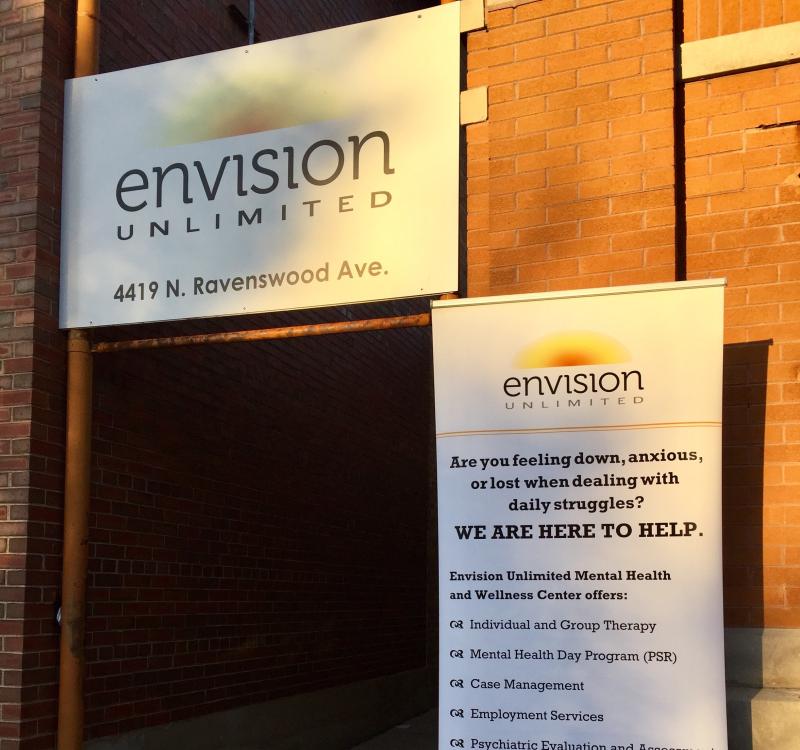
Main Office: 4419 N. Ravenswood Ave., Chicago, IL 60640
Office Hours: Mon-Fri – 9:00 AM – 5:00 PM
Our Core Services
Screening and Assessment
All clients receive a comprehensive behavioral health assessment designed to identify disorders consistent with the DSM-5 and ICD-10. We utilize the Illinois Medicaid Comprehensive Assessment of Needs and Strengths (IM+CANS) to guide this process. This assessment helps establish a clear understanding of each individual’s needs, strengths, and clinical presentation to inform appropriate services and supports.
Treatment Planning
Clients collaborate with staff to complete the Integrated Assessment and Treatment Planning (IATP). This integrated service plan ensures that identified needs and strengths are clearly documented and translated into specific, measurable treatment recommendations and interventions. The IATP is reviewed and updated at least every 180 days to ensure ongoing relevance and effectiveness of care.
Care Coordination
Our nurses and care coordinators support individuals with mental illness in accessing a broad range of services, including medical care, psychiatric treatment, substance use treatment, and supports addressing social determinants of health. Care coordination promotes communication among clinicians, healthcare providers, clients, families, and other key supports to improve overall recovery outcomes.
This service is especially beneficial for individuals with complex mental and physical health needs, including those transitioning from long-term care settings back into the community. These individuals are at higher risk of fragmented care due to involvement with multiple systems and providers. Our multidisciplinary approach helps individuals access coordinated care across all service providers and strengthening psychosocial supports, self-management skills, and clinical treatment engagement.
Therapeutic Services
Counseling for adults and youth in individual or group settings, available in person or via telehealth
- Crisis Intervention
- Crisis Stabilization
- Psychiatric Services
- Community Support
- Outpatient Clinic
- Nursing Services for residential clients
- Client-Centered Consultation Case Management (CM)
- Mental Health Case Management
- Transition, Linkage and Aftercare Case Management
- Assertive Community Treatment (ACT)
- Individual Placement and Support (IPS)
- Medication Monitoring and Training
- Substance Use Disorder Treatment
- Psychosocial Rehabilitation (PSR)
- Community Support Team (CST)
It is the policy and practice of our Mental Health Center to not discriminate in the provision of health care services to an individual:
- Because the individual is unable to pay for the health care services;
- Because payment for those services would be made under Medicare, Medicaid, or the Children’s Health Insurance Program (CHIP); or
- Based upon the individual’s race, color, sex, age, national origin, disability, religion, gender identity or sexual orientation.
Therapists & Counselors
Our therapists are trauma-informed and are trained to utilize techniques ranging from Mindfulness, Cognitive Behavioral Therapy, Motivational Interviewing, Art Therapy, and more.
Ashley Freedman, MS, QMHP
Our Mental Health Specialist who received her bachelor's degree in psychology from Michigan State University and attained a master's degree in forensic psychology from The Chicago School of Professional Psychology. Ashley has been working in the field since 2017 as a Therapist and QMHP. She utilizes different approaches and interventions such as CBT, solution-focused therapy, and motivational interviewing to fit the needs and goals of her clients. Ashley is certified in crisis intervention, is an experienced case manager, as well as group facilitator specializing in psycho-social rehabilitation with adults with severe mental health diagnosis.
Our Therapeutic Services Explained
Psychiatric Services: Our psychiatrist conducts the initial evaluation of the patient’s diagnosis, level of functioning and need for psychotropic medications. The psychiatrist provides prescriptions, and ongoing medical monitoring related to the patient’s use of psychotropic medication. Our Medical Director is Jeffrey Tilkin, MD., Director of Psychiatry at Swedish Hospital.
Crisis Intervention: Crisis Intervention includes specific crisis intervention, de-escalation, and response techniques. The goal is to restore the client to optimal functioning to avoid hospitalization or placement in a higher level of care.
Therapy/Counseling: This includes a variety of treatment modalities and clinical techniques, with an emphasis on evidence-informed practices. Our integrative approach promotes positive pro-social, emotional, cognitive, behavioral, or psychological changes with the client.
Community Support: This includes the facilitation of illness self-management techniques, identification and use of natural supports, development of functional, interpersonal, and community-based coping skills, and other clinically informed efforts to support the recovery of the client. Additionally, Community Support includes efforts to increase targeted strengths or reduce targeted needs, as identified in the client’s IATP.
Medication Monitoring: This includes observation, evaluation and discussion of target symptoms, responses, and adverse effects of medications by our psychiatrist and nursing staff. Additionally, the service provides for the review and explanation of laboratory results to clients and provider activities to investigate and identify new target symptoms from medications, such as performing screens for tardive dyskinesia.
Medication Training: This includes a provider training client on self-administration and safeguarding (adverse reactions, storage, etc.) of medication and communication with other professionals, family or caregivers on medication usage, potential issues, and means to actively seek assistance in the event of an issue or emergency.
Client-Centered Consultation Case Management (CM): This includes client-specific professional communications among provider staff or between provider staff and staff of other providers who are involved with service provision to the client. Professional communications include offering or obtaining a professional opinion regarding the individual's current functioning level or improving the client's functioning level, discussing the client's progress in treatment, adjusting the client's current treatment, or addressing the client's need for additional or alternative mental health services.
Mental Health Case Management: This includes assessment, planning, coordination, and advocacy services for clients who need multiple services and require assistance in gaining access to and in using behavioral health, physical health, social, vocational, educational, housing, public income entitlements and other community services to assist the client in the community.
Transition, Linkage and Aftercare Case Management: This is inclusive of efforts to assist in the effective transition in living arrangements, consistent with the client's welfare and development. This includes discharge from institutional settings, transition to adult services (transition age), and assisting the client or the client's family or caretaker with the transition.
Crisis Stabilization: Includes observing the client in their natural environment during periods of high stress, providing coaching to the client in the usage of their crisis safety plan; modeling positive coping skills and response patterns to the client’s parent/caregiver; redirecting a client’s behaviors when they begin to escalate; educating the client on responding and reducing environmental stressors and stimuli when the client is feeling overwhelmed, providing crisis de-escalation, and providing a crisis response in the event the client experiences a behavioral health crisis. Crisis Stabilization Services target periods of high stress and transition with the goal of reducing crisis episodes and institutionalizations.
Community Support Team (CST): The service of CST is provided under the direction of a full-time QMHP and is available to the client 24 hours a day, every day of the year. Utilizing a multi-disciplinary team approach the service is intended to decrease institutional and behavioral health crisis episodes while increasing community functioning to achieve rehabilitative, resiliency and recovery goals.
Assertive Community Treatment (ACT): This is an evidenced based practice with a nationally normed fidelity model utilizing a multi-disciplinary team approach to service delivery. The team is comprised of a psychiatrist, nurse, Team Leader, social workers, therapists, counselors, and peer mentors. The service array encompasses the integration of crisis intervention, treatment services and rehabilitative support focused on skill building and stabilization to promote and maintain community living. ACT services are available to the Client 24 hours a day, every day of the year, and are provided by a multidisciplinary team.
Psychosocial Rehabilitation (PSR): The service of PSR is provided under the direction of a full-time QMHP who engages in direct provision of services, and includes cognitive behavioral interventions, development of problem-solving skills, interventions to reduce or ameliorate symptoms of a co-occurring disorder and other interventions provided through individual and group sessions delivered on-site via organized programming and active treatment. The focus of treatment interventions includes capacity building to facilitate stability, adaptation, problem solving, coping skills, and independent living when age appropriate. PSR services are provided daily offering curriculum-based groups to promote the client’s recovery and independence.
Individual Placement and Support (IPS): This is an evidenced-based practice model of Supported Employment. IPS is proven through research to be the most effective approach to helping individuals with mental illness to attain and maintain competitive employment within the community.
Outpatient Clinic: The clinic provides a wide range of mental health services that include outpatient individual and group counseling, psychiatric evaluation with medication monitoring, case management services, and care coordination.
Nursing Services for residential clients: Our program provides appointment management for clients to their primary care providers, psychiatry, vision, women’s health, podiatry, and dental clinics. The nurses also provide psychotropic medication injections under the supervision of the psychiatrist.